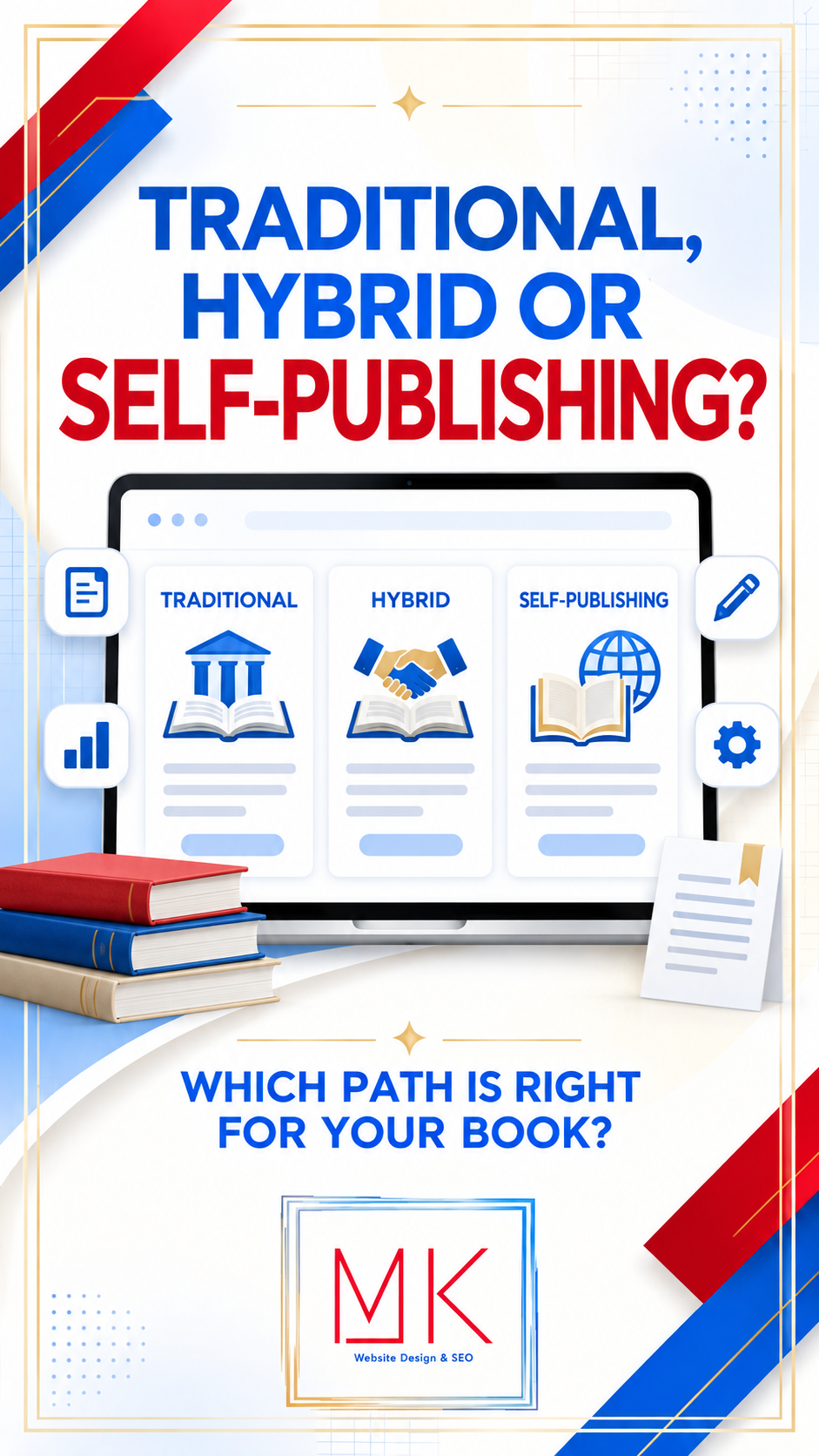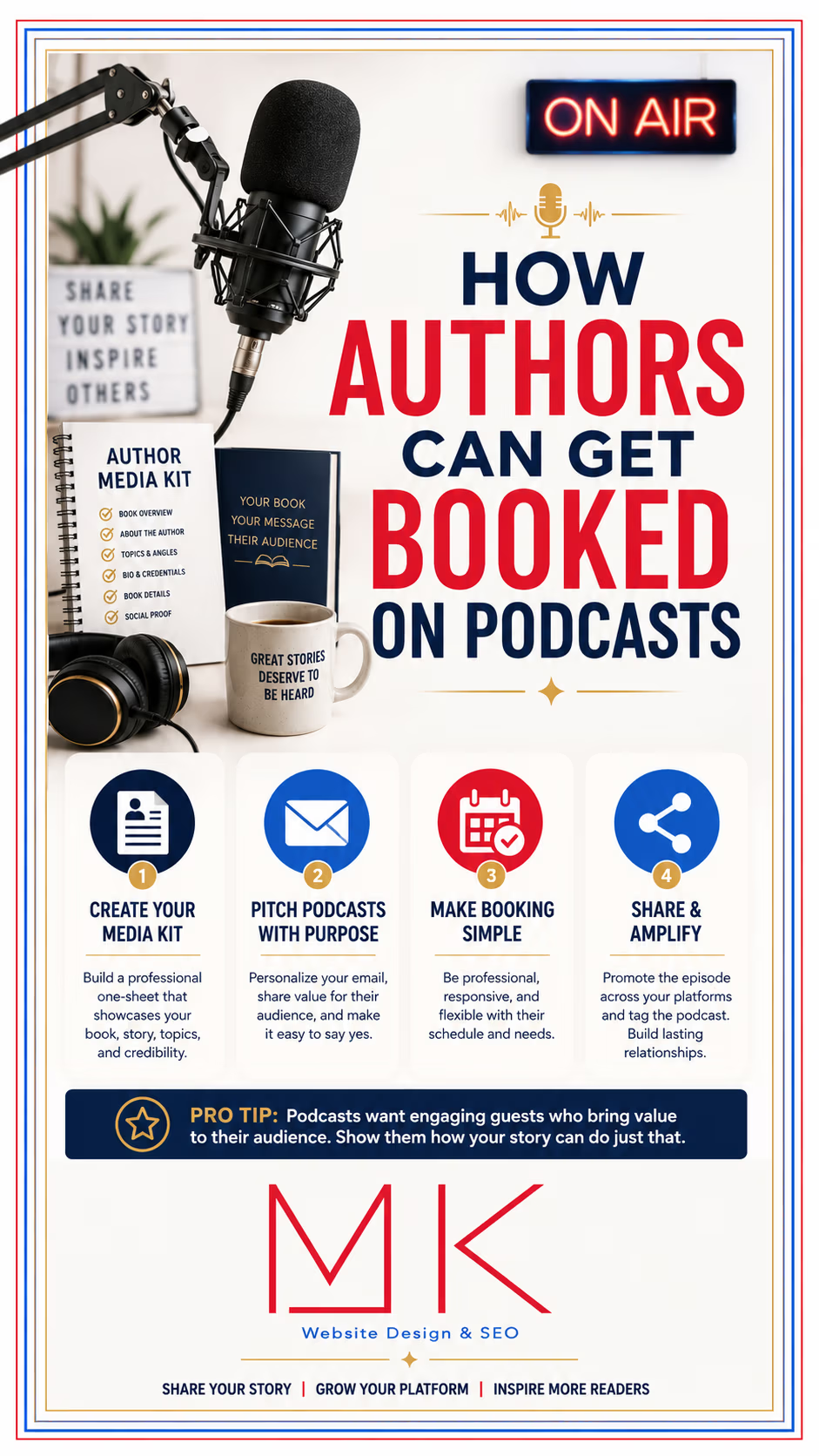
Publishing a book is no longer a one-path journey.
Today, authors can pursue a traditional publishing contract, partner with a hybrid publisher, or independently publish their work. Each option can lead to a professionally produced, widely available book—but the responsibilities, costs, rights, royalties, timelines, and level of creative control can be very different.
That is why the best question is not, “Which type of publishing is best?”
The better question is:
“Which publishing path best supports this book, this author, and these goals?”
An author seeking national bookstore placement and the support of an established publishing team may prioritize different opportunities than a business owner publishing a book to support speaking engagements. A novelist building a rapid-release series may need a different timeline than a memoirist hoping to attract a literary agent. A children’s author may place particular importance on illustration quality, printing specifications, and school or library distribution.
Before choosing a path, authors need to understand what each publishing model actually provides, what it may require, and what questions should be answered before signing an agreement or paying for services.
In this guide, MK Marketing explains the differences between traditional, hybrid, and self-publishing so authors can make a more informed decision about the future of their book.
What Does a Publisher Actually Do?
A publisher is responsible for bringing a book from manuscript to marketplace.
Depending on the publishing model and contract, this work may include:
- Evaluating or acquiring the manuscript
- Developmental editing
- Copyediting
- Proofreading
- Cover design
- Interior formatting
- Ebook conversion
- ISBN assignment
- Metadata development
- Pricing
- Printing or print-on-demand setup
- Retail and wholesale distribution
- Sales representation
- Advance review copies
- Publicity and marketing
- Rights licensing
- Royalty reporting
- Author payments
The central difference between publishing models is not whether these tasks must be completed. Every professionally published book needs many of them.
The differences are who selects the book, who pays for the work, who controls the decisions, who owns or licenses the rights, who receives the sales income, and who carries the financial risk.
The Three Primary Publishing Paths
At a glance:
| Publishing path | Who generally funds publication? | Who controls the process? | How is the manuscript accepted? |
|---|---|---|---|
| Traditional publishing | The publisher | Primarily the publisher, subject to the contract | Competitive acquisition process |
| Hybrid publishing | The author contributes financially | Shared or contractually divided | A legitimate hybrid should vet submissions |
| Self-publishing | The author | The author | The author decides when the book is ready |
These are general descriptions. Publishing agreements vary, and the exact contract—not the label on a company’s website—determines the author’s rights, costs, obligations, and compensation.
What Is Traditional Publishing?
In traditional publishing, a publishing house acquires the right to publish a manuscript under an agreed contract.
The publisher generally assumes the financial risk of producing and distributing the book. The author does not pay the publisher to be published. Depending on the publisher and agreement, the author may receive an advance against future royalties.
Most large traditional publishers and many established independent presses accept primarily agented submissions. Some smaller presses accept manuscripts directly during open submission periods or through contests and special calls.
How Traditional Publishing Usually Works
The process may include:
- The author completes and revises the manuscript or, for some nonfiction projects, prepares a book proposal.
- The author researches and queries literary agents or publishers accepting direct submissions.
- An agent may offer representation and submit the project to editors.
- An interested publisher evaluates the manuscript, market, audience, author platform, and sales potential.
- The publisher makes an offer.
- The author, usually with an agent or attorney, negotiates the contract.
- The publisher schedules editing, design, production, distribution, and publication.
- The book is released according to the publisher’s timeline and sales strategy.
This is a selective process. A strong manuscript can be declined because of the publisher’s current list, market expectations, competing titles, timing, budget, sales projections, or uncertainty about how to position the book.
A rejection does not automatically mean the book lacks value. It means that particular agent or publisher did not choose to invest in that project at that time.
Potential Benefits of Traditional Publishing
The Publisher Assumes the Primary Financial Risk
The publisher generally pays for professional editing, design, production, printing, and distribution. The author should not be charged a publication fee by a traditional publisher.
Professional Publishing Team
The book may receive support from experienced editors, designers, production specialists, sales representatives, publicists, rights professionals, and distribution partners.
The amount of attention varies by publisher, title, budget, and expected market potential.
Established Trade Relationships
Traditional publishers may have established relationships with booksellers, wholesalers, libraries, reviewers, media outlets, and international rights partners.
That does not guarantee bookstore placement or media coverage, but the publisher may be able to present the title through recognized sales channels.
Industry Validation
Being selected by an established publisher can provide professional validation and may help with certain awards, reviews, media opportunities, speaking engagements, and bookstore conversations.
Possibility of an Advance
Some contracts include an advance against royalties. An advance is normally paid before the book earns that amount through sales. The author generally begins receiving additional royalties only after the advance has earned out. The Authors Guild explains that a traditional advance is ordinarily not repaid merely because sales fall short, although authors must review the specific agreement. Learn more about publishing advances from the Authors Guild.
Possible Tradeoffs of Traditional Publishing
The Process Can Take Considerable Time
Finding an agent may take months or years, and representation does not guarantee a publishing contract. After acquisition, the publication date may be scheduled far in advance.
The Author Gives Up Some Control
The publisher may have final or substantial control over:
- Title
- Cover
- Editing
- Format
- Pricing
- Publication date
- Distribution
- Marketing positioning
- Retail discounts
- Whether another edition is produced
Good publishers collaborate with authors, but the contract determines who has approval and who is merely consulted.
Royalty Percentages Are Generally Lower
Because the publisher pays the production expenses and assumes the financial risk, the author usually receives a contracted royalty rather than the full net income from each sale.
Royalties can vary by format, sales channel, discount, quantity, and whether they are based on list price or the publisher’s net receipts.
Rights May Be Licensed for a Long Period
Traditional contracts can include print, ebook, audiobook, translation, territorial, adaptation, and other rights. Authors should understand exactly which rights are being granted, for how long, and under what conditions those rights can revert.
The Authors Guild notes that many traditional contracts grant rights for the full term of copyright, making a meaningful out-of-print and rights-reversion clause particularly important. Review the Authors Guild’s guidance on rights reversion.
Marketing Is Still an Author Responsibility
Traditional publication does not eliminate the need for author marketing.
Many authors are still expected to participate in:
- Social media
- Email marketing
- Interviews
- Events
- Bookstore outreach
- Speaking
- Reader engagement
- Website development
- Launch activities
The publisher’s marketing plan may be strongest around release and may vary significantly according to the title’s priority.
Traditional Publishing May Be a Good Fit When…
- You want to pursue an established publisher and are prepared for a competitive process.
- You do not want to fund publication yourself.
- You are willing to wait for querying, acquisition, and the publisher’s production schedule.
- You are comfortable sharing creative and business control.
- Your genre performs well in traditional trade channels.
- You want an experienced team to direct production.
- You have a marketable manuscript or nonfiction proposal.
- You are prepared to promote the book even with publisher support.
What Is Hybrid Publishing?
Hybrid publishing combines elements of traditional and self-publishing.
Like a traditional publisher, a legitimate hybrid publisher should evaluate submissions, maintain professional editorial standards, publish under its imprint, and provide a coordinated publishing process. Unlike a traditional publisher, it requires the author to contribute financially toward publication.
In exchange for that investment, the author should generally receive better royalty terms, greater collaboration, and clearer benefits than would ordinarily be available through a traditional contract.
However, hybrid publishing is one of the most misunderstood and inconsistently used terms in the industry.
Some reputable companies operate under a genuine hybrid model. Others use the word “hybrid” to make an expensive service package sound selective or prestigious.
The label alone proves nothing.
What Should a Legitimate Hybrid Publisher Provide?
The Independent Book Publishers Association maintains an 11-point Hybrid Publisher Criteria checklist. It says a qualifying hybrid publisher should, among other requirements:
- Define a clear mission and publishing vision
- Vet submissions
- Operate transparently
- Use a publisher imprint and acquire its own ISBNs
- Publish to professional industry standards
- Ensure editorial, design, and production quality
- Pursue and manage a range of publishing rights
- Provide effective distribution beyond simply uploading a listing
- Demonstrate respectable sales
- Pay authors a higher-than-standard royalty
Authors should evaluate a company against the complete criteria rather than relying on isolated promises. Review the IBPA Hybrid Publisher Criteria.
How Hybrid Publishing Usually Works
The process may include:
- The author submits a manuscript or proposal.
- The publisher evaluates whether the book fits its list and standards.
- The publisher offers a contract and outlines the author’s required investment.
- The contract identifies the services, rights, royalty structure, schedule, distribution, and marketing commitments.
- The author pays an agreed amount or shares production expenses.
- The publisher manages editing, design, production, and distribution.
- The author and publisher share revenue according to the agreement.
The author’s required investment can be substantial. The Authors Guild advises authors to examine the publisher’s actual services, editorial standards, finished books, marketing commitments, and compliance with the IBPA criteria before signing. Read the Authors Guild’s hybrid-contract guidance.
Potential Benefits of Hybrid Publishing
Coordinated Professional Support
A capable hybrid publisher can provide one organized team for editing, design, production, distribution, and selected marketing activities.
More Accessible Than Traditional Acquisition
Hybrid publishers may accept projects that are commercially strong but do not fit the list, scale, or risk profile of a traditional house.
They should still be selective. If every manuscript is accepted as long as the author can pay, the company is operating more like a publishing-services provider or vanity press than a selective hybrid publisher.
Potentially Faster Timeline
Hybrid publication can be faster than pursuing agents and traditional acquisition, although professional editing and production still require time.
Greater Collaboration
Depending on the contract, authors may have more input into the cover, editing, pricing, positioning, and marketing than they would under a traditional arrangement.
Higher Royalty Percentage
Because the author helps finance publication, the author should normally receive a significantly higher share of net sales than under a traditional contract.
Possible Tradeoffs of Hybrid Publishing
Significant Upfront Investment
Authors may pay thousands or tens of thousands of dollars. A high price does not guarantee quality, distribution, reviews, bookstore placement, marketing results, or sales.
The Term Is Frequently Misused
An author may believe a company is investing in the book when the company’s main income actually comes from selling services to authors.
Contract Terms Vary Widely
Authors must determine:
- Who owns the ISBN
- Whose name appears as publisher
- Which rights are granted
- How long the agreement lasts
- How rights can be recovered
- Who owns the source files
- Who controls retailer accounts
- How royalties are calculated
- What expenses are deducted
- Who receives sales income first
- What “distribution” actually means
- What marketing is contractually promised
Distribution May Be Overstated
“Available to bookstores” does not mean “stocked in bookstores.”
A book can be listed in a wholesale catalog without a sales representative actively presenting it to booksellers. Authors should ask whether distribution includes trade sales representation, what wholesale discount is offered, whether books are returnable, and whether the publisher has a documented record of bookstore and library sales.
The Author May Still Carry Most of the Marketing Burden
Some packages include only a press release, a few graphics, or a listing on the publisher’s website. Authors should request a written explanation of every marketing deliverable, its timing, duration, and responsible party.
Hybrid Publishing May Be a Good Fit When…
- You want a coordinated publishing team.
- You can comfortably afford the investment without relying on guaranteed sales.
- The publisher is selective and meets recognized professional standards.
- The contract offers meaningful rights protection and appropriate royalties.
- You have reviewed books and spoken with several of the publisher’s authors.
- The company demonstrates real distribution and sales performance.
- You understand exactly what is—and is not—included.
- You prefer shared support over independently managing freelancers.
What Is Self-Publishing?
In self-publishing, the author acts as the publisher.
The author controls the book’s rights, budget, production decisions, publication schedule, pricing, distribution strategy, and marketing. The author may personally complete some tasks and hire qualified professionals for others.
Self-publishing does not have to mean homemade, unedited, or unprofessional.
It also does not mean the author must become an expert editor, cover designer, formatter, metadata specialist, and marketer overnight.
A self-published author can assemble a professional team that includes:
- Developmental editor
- Copyeditor
- Proofreader
- Cover designer
- Interior formatter
- Illustrator
- Ebook formatter
- Publishing consultant
- Metadata specialist
- Website designer
- Publicist
- Book marketer
The defining characteristic is that these professionals work for the author. The author remains the publisher and decision-maker.
The Authors Guild describes independent publishing as a model in which authors manage publication themselves, whether they perform the work personally or hire experts for specialized tasks. Explore the Authors Guild’s overview of publishing alternatives.
How Self-Publishing Usually Works
The process may include:
- The author completes and revises the manuscript.
- The author establishes a realistic publishing budget and schedule.
- Professional editing is completed.
- The author selects a title, subtitle, imprint, and publication plan.
- The cover and interior are professionally designed.
- The author purchases ISBNs or evaluates platform-provided identifiers.
- Book descriptions, categories, keywords, pricing, and other metadata are prepared.
- The author creates publishing and distribution accounts.
- Print and ebook files are uploaded and reviewed.
- Physical and digital proofs are checked carefully.
- Corrections are made before publication.
- The author launches and markets the book.
- The author monitors sales, payments, reviews, metadata, and future opportunities.
Platforms such as Amazon Kindle Direct Publishing, IngramSpark, and Draft2Digital give independent authors access to print-on-demand, ebook, retailer, wholesale, and library distribution options. Each platform has different strengths, requirements, costs, and distribution relationships; authors must avoid overlapping distribution and inconsistent metadata.
Potential Benefits of Self-Publishing
Creative Control
The author can make final decisions about:
- Title and subtitle
- Cover
- Interior design
- Editing
- Illustrations
- Book length
- Formats
- Pricing
- Publication date
- Branding
- Marketing message
Faster, Author-Controlled Schedule
The author does not need to spend years querying or wait for a publisher’s acquisition calendar. The book can be released when it is professionally ready and aligned with the author’s business or marketing plans.
Ownership and Flexibility
The author normally retains the rights and can update the book, change prices, release new editions, add formats, revise metadata, or hire different professionals.
Direct Access to Publishing Information
When authors publish through accounts they own, they can see sales reports, royalties, pricing, files, and metadata directly.
Potentially Higher Income Per Sale
The author receives the available platform compensation after retailer, distribution, printing, delivery, and other applicable costs. There is no traditional publisher dividing the author’s contractual share.
This does not guarantee greater total income. A higher amount per copy only becomes meaningful when readers purchase the book.
Long-Term Availability
Print-on-demand technology can keep a book available without requiring the author to purchase and store a large inventory.
Ability to Build a Publishing Business
Authors can establish an imprint, develop a backlist, publish companion materials, create revised editions, and make decisions across an entire series.
Possible Tradeoffs of Self-Publishing
The Author Funds the Project
Professional editing, design, formatting, illustration, ISBNs, proofs, marketing, and other services require a budget.
The Author Carries the Financial Risk
There is no guarantee that the book will earn back its production and marketing costs.
Quality Control Is the Author’s Responsibility
Publishing platforms provide access, not editorial approval. A platform may accept a file that contains typographical errors, poor formatting, an ineffective cover, or inaccurate metadata.
Distribution Requires Strategy
Making a book available online is not the same as creating reader demand or bookstore placement. The author must understand retailer distribution, wholesale terms, returnability, direct sales, and marketing.
The Author Must Manage the Team
Hiring qualified professionals requires research, contracts, scheduling, communication, and quality review.
Marketing Remains Essential
The author is responsible for developing visibility through an author website, email marketing, social media, reviews, media outreach, events, advertising, book clubs, speaking, and long-term promotion.
Self-Publishing May Be a Good Fit When…
- You want to retain creative and business control.
- You are prepared to fund professional production.
- You want to choose your publication schedule.
- You are publishing a series or plan to release books regularly.
- Your book supports a business, speaking career, ministry, organization, or professional platform.
- You want direct access to accounts, sales reports, and royalties.
- You are willing to manage professionals or hire someone to coordinate the process.
- You understand that publishing and marketing are separate responsibilities.
Assisted Self-Publishing Is Not the Same as Hybrid Publishing
Authors do not have to choose between doing everything alone and transferring their book to a publishing company.
With assisted self-publishing, the author remains the publisher while hiring freelancers, consultants, or agencies for specific services.
For example, an author may hire professionals to:
- Edit the manuscript
- Design the cover
- Format the interior
- Prepare the ebook
- Develop metadata
- Set up ISBN records
- Upload files
- Review platform settings
- Coordinate proofs
- Create a website
- Develop a marketing campaign
The author can still maintain ownership of the publishing accounts, ISBNs, files, rights, sales information, and royalty payments.
This differs from a hybrid arrangement in which a publishing company releases the book under its publishing program and imprint according to a broader contract.
The distinction should be clear in every agreement:
- Is the company the publisher, or is it a service provider?
- Whose imprint appears on the book?
- Who owns the ISBN?
- Who controls the retailer and distributor accounts?
- Who receives the royalties?
- Who owns the final and source files?
- Can the author hire another provider later?
Traditional vs. Hybrid vs. Self-Publishing: Side-by-Side Comparison
| Consideration | Traditional | Hybrid | Self-publishing |
|---|---|---|---|
| Manuscript selection | Highly selective | Should be vetted and selective | Author decides |
| Upfront author payment to publisher | Generally no | Yes | Author pays chosen providers and platform costs |
| Advance | Sometimes | Generally no | No |
| Financial risk | Primarily publisher | Shared, with substantial author contribution | Author |
| Creative control | Primarily publisher | Shared according to contract | Author |
| Timeline | Often longest | Often moderate | Author-controlled |
| Editing and design | Publisher manages | Publisher manages | Author hires or manages |
| ISBN and imprint | Publisher | Hybrid publisher | Author or author’s imprint when using owned ISBNs |
| Rights | Licensed according to contract | Contract varies | Author generally retains rights |
| Royalty share | Contracted, generally lower | Should be higher than traditional | Platform income after applicable costs |
| Account access | Publisher controls distribution accounts | Publisher generally controls its accounts | Author should control author-owned accounts |
| Bookstore access | Strongest potential trade infrastructure | Depends on actual distribution and sales reach | Possible, but requires appropriate setup and active outreach |
| Marketing | Shared; level varies | Shared; must be defined | Author’s responsibility |
| Ability to update the book | Publisher-controlled | Contract-controlled | Author-controlled |
| Best advantage | Publisher investment and infrastructure | Coordinated support with greater author participation | Ownership, speed, flexibility, and control |
| Primary risk | Loss of control and lengthy process | Paying heavily without receiving genuine publishing value | Underestimating quality, management, and marketing requirements |
Publishing Terms Authors Should Understand
Before evaluating an offer or service, become familiar with these terms.
Rights
Rights determine who may publish, reproduce, distribute, translate, adapt, record, or license the work. Never grant rights simply because they appear in a standard contract. Confirm that the company can meaningfully use every right it requests.
Royalty
A royalty is the author’s contracted share of book income. Determine whether it is calculated from list price, net receipts, or another amount—and what costs may be deducted first.
Advance
An advance is generally an upfront payment against royalties the book is expected to earn. The payment schedule and earning provisions should be stated in the contract.
ISBN
An International Standard Book Number identifies a particular edition and format of a book. In the United States, Bowker is the official ISBN agency. Review ISBN information from Bowker.
The ISBN registrant is associated with the publishing identity in industry records. Authors planning an independent imprint should understand the difference between purchasing ISBNs and accepting free platform-assigned identifiers.
Imprint
An imprint is the publishing name associated with a book. It may belong to a traditional or hybrid publisher, or it may be established by a self-published author.
Distribution
Distribution makes a book available to retailers, wholesalers, libraries, or other sales channels. Availability does not guarantee that a retailer will stock, display, recommend, or sell the book.
Returnability
Bookstores traditionally expect the ability to return unsold books. Returnability may increase ordering opportunities but also exposes the publisher or self-published author to returned-copy costs.
Net Receipts
Net receipts generally refer to the money received after specified discounts, fees, returns, or other deductions. The contract should define the term precisely.
Rights Reversion
Rights reversion returns licensed publishing rights to the author under defined circumstances. The contract should contain meaningful sales or royalty thresholds and a clear procedure.
Questions to Ask Any Publisher Before Signing
Do not rely only on a sales conversation. Request clear written answers and make sure important promises appear in the contract.
Ask:
- Is this traditional, hybrid, or publishing-services agreement?
- Which rights am I granting?
- Are the rights exclusive?
- Which territories and languages are included?
- How long does the agreement last?
- How can I terminate the agreement?
- Under what conditions do my rights revert?
- Who owns the ISBN?
- Whose imprint will appear on the book?
- Who owns the edited manuscript, cover, illustrations, interior, EPUB, and source files?
- Will I receive all final files?
- Who controls the retailer and distributor accounts?
- Who sets the price?
- Who approves the cover and edits?
- What will I pay, and when?
- Can the price increase after work begins?
- What is excluded from the quoted price?
- How are royalties calculated?
- Which expenses are deducted before royalties are calculated?
- How often will I receive reports and payments?
- What happens to sales income if the company closes?
- What distribution is included?
- Does distribution include an active sales team or only catalog availability?
- What wholesale discount and return status will be used?
- What marketing activities are contractually guaranteed?
- How long will the marketing support continue?
- Can I see several recently published books?
- Can I speak privately with current and former authors?
- Has the company had complaints involving royalties, rights, or unfulfilled services?
- Can an attorney or publishing professional review the contract before I sign?
Publishing Warning Signs
Pause and investigate if a company:
- Guarantees bestseller status
- Guarantees a traditional publishing contract later
- Claims major studios or publishers are waiting to acquire your book
- Pressures you to pay immediately
- Refuses to provide the complete contract in advance
- Cannot explain its royalty calculation
- Uses “distribution” without naming the actual channels or services
- Suggests bookstore availability means guaranteed shelf placement
- Accepts every manuscript without meaningful review
- Earns primarily from author fees but presents itself as a selective publisher
- Charges unexplained recurring fees
- Requires unnecessary rights
- Makes rights reversion extremely difficult
- Keeps all production files without explaining why
- Controls the book indefinitely after services have been paid for
- Refuses to provide references from its authors
- Uses copied, poor-quality, or highly repetitive book designs
- Has frequent complaints about missing royalty payments
- Contacts an author unexpectedly with an unrealistic film, foreign-rights, or acquisition offer
- Impersonates a recognizable publisher, agent, organization, or entertainment professional
Publishing scams increasingly target authors with flattering but unrealistic opportunities. The Authors Guild maintains current scam alerts and recommends verifying unsolicited offers before sending money or sensitive information. Review the Authors Guild’s Publishing Scam Alerts.
How to Decide Which Publishing Path Is Right for You
Begin with your goals instead of a company name.
Choose Your Primary Goal
Is your highest priority:
- Securing a traditional publishing deal?
- Releasing the book by a specific date?
- Retaining full creative control?
- Minimizing personal financial investment?
- Reaching bookstores and libraries?
- Supporting a business or speaking career?
- Publishing a series quickly?
- Building your own publishing imprint?
- Having one company coordinate the entire process?
- Maximizing flexibility for future editions?
You may want several of these things, but ranking them will expose the tradeoffs you are willing to make.
Evaluate Your Resources
Consider:
- Available budget
- Available time
- Publishing knowledge
- Project-management ability
- Author platform
- Marketing experience
- Professional network
- Willingness to wait
- Comfort with financial risk
- Need for creative control
Consider the Book Itself
Ask:
- What is the genre?
- Who is the intended reader?
- How do readers usually discover books like this?
- Is the topic timely?
- Does the book need to support an upcoming event or business launch?
- Is it part of a series?
- Does it require costly illustrations, photography, permissions, or specialty printing?
- Is there a strong traditional market for it?
- Does the author have a platform that can drive direct sales?
Calculate More Than the Publishing Price
Consider the complete cost of:
- Editing
- Proofreading
- Cover design
- Formatting
- Illustration
- ISBNs
- Permissions
- Proof copies
- Printing
- Distribution
- Website development
- Review copies
- Marketing
- Publicity
- Advertising
- Events
- Ongoing updates
The least expensive offer is not always the least costly decision. A poorly produced book may later require new editing, redesign, reformatting, ISBNs, and republication.
Review the Contract Independently
Before granting rights or making a large payment, consider having the agreement reviewed by a qualified publishing attorney or an experienced author-rights organization.
Do not depend on the company selling the agreement to explain whether the agreement protects you.
Can an Author Use More Than One Publishing Path?
Yes. An author does not need to choose one model for an entire career.
An author may:
- Traditionally publish one book and self-publish another
- Self-publish a backlist after rights revert
- Pursue traditional publication for fiction and independently publish professional nonfiction
- Use a hybrid publisher for a complex illustrated project
- Self-publish companion workbooks while a traditional publisher controls the main title
- License audiobook or foreign rights separately when the contract permits
This is sometimes called being a hybrid author, which is different from publishing with a hybrid publisher.
A hybrid author uses more than one publication model. A hybrid publisher is a company operating under a particular author-subsidized business model.
There Is No Universal “Best” Publishing Path
Traditional publishing can provide professional investment, established infrastructure, and valuable industry relationships—but it is selective, slow, and requires the author to surrender some control.
Hybrid publishing can provide coordinated professional support and a faster route to market—but it requires careful vetting, a substantial investment, and a strong contract.
Self-publishing can provide ownership, flexibility, speed, and creative control—but the author assumes the financial risk and responsibility for professional quality, distribution, and marketing.
The strongest choice is the one made with realistic expectations and verified information.
Do not choose a publishing path because someone promises that it is easy. Choose it because you understand the responsibilities, the contract supports your goals, and the people involved can demonstrate that they are qualified to help bring your book to readers.
Publishing With Control—and Professional Help
Self-publishing does not require an author to navigate every platform and production decision alone.
MK Marketing helps authors prepare and upload books through author-owned publishing accounts. Authors maintain control of their rights, royalties, pricing, files, and publishing decisions while receiving experienced assistance with metadata, platform setup, distribution selections, file review, publication, websites, and book marketing.
Your book deserves more than a quick upload. It deserves a publishing plan built around your goals.
Next in the MK Marketing Publishing Paths Series: The Benefits of Self-Publishing: Creative Control, Ownership, and Flexibility.